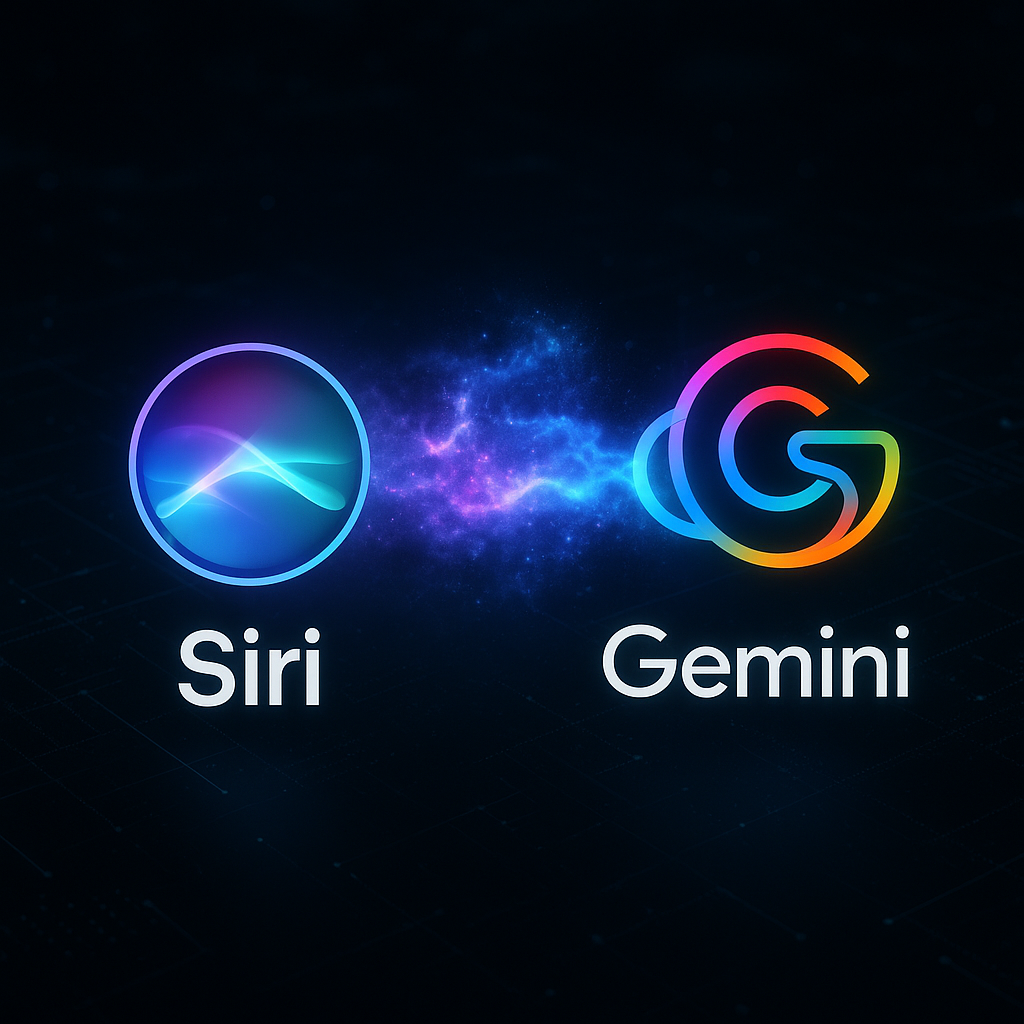
Apple Will Use Google’s Gemini to Power the New Siri
OpenAI teams up with Amazon in a $38B deal to supercharge AI, promising smarter tools for our daily lives!

🔥 What happened
Let’s be honest... Siri hasn’t exactly been the brightest star in the AI galaxy lately.
She can set timers, tell bad jokes, and occasionally misunderstand half of what you say.
Meanwhile, ChatGPT is writing essays, Gemini is generating music videos, and even your smart fridge probably sounds more helpful.
Now Apple’s had enough.
According to Bloomberg and Reuters, Apple is reportedly striking a deal with Google to power the next generation of Siri with Gemini, Google’s cutting-edge AI model. The deal could be worth around $1 billion per year, a huge move that might finally make Siri… well, smart.
⚙️ How it works
This isn’t just a software update. Apple is planning a full AI makeover called Apple Intelligence, and Gemini will be a key part of it.
Here’s the setup:
- Apple’s own small AI models will handle quick, private tasks directly on your device, things like opening apps or setting reminders.
- Google’s Gemini, a gigantic AI model (reportedly 1.2 trillion parameters strong), will step in for heavy-duty thinking, like summarizing emails, planning your week, or holding a real conversation.
- Everything will run through Apple’s Private Cloud Compute, meaning all the data stays under Apple’s control, not Google’s.
So, you get Google’s brainpower with Apple’s privacy wall. Not bad.
🧠 Why Apple needs this
Apple’s been quietly building its own AI for years… but compared to ChatGPT or Gemini, Siri still feels stuck in 2015. She’s polite but painfully limited, a little like that coworker who still prints out every email.
Apple knows it’s late to the generative AI party. Its in-house models (around 150 billion parameters) are decent, but nowhere near the scale or fluency of Gemini. So instead of reinventing the wheel, Apple’s doing the smart thing: partnering with the competition.
By licensing Gemini, Apple can:
- Roll out next-gen Siri faster — no need to train a trillion-parameter beast from scratch.
- Keep its privacy-first reputation, since data stays on Apple servers.
- Let Siri finally sound like a conversational assistant instead of a voice command machine.
💬 What the new Siri could do
If the partnership works, Siri might finally act like an AI assistant you actually want to talk to:
- Summarize your long group chats into bullet points.
- Write your emails in your tone of voice.
- Plan your trips, book flights, and adjust plans if something changes.
- Understand context — like knowing “call her back” means your friend, not your boss.
And all of this could happen as early as late 2025, with a full rollout expected by spring 2026.
🔍 Why Google said yes
For Google, this deal is pure win.
Not only does it bring in over a billion dollars a year, it also cements Gemini as the go-to AI platform even Apple can’t resist using.
That’s like Coca-Cola asking Pepsi to fix its recipe.
It’s also great PR for Gemini — showing that it’s scalable, stable, and enterprise-grade enough to power the world’s most famous voice assistant.
⚠️ What’s still unclear
- Neither Apple nor Google has officially confirmed the deal.
- Siri may use Gemini for select features (like reasoning and summarization) while Apple’s smaller models handle the rest.
- Apple could still add more AI partners later — it’s already in talks with OpenAI for additional integrations.
So it’s not “Siri powered by Google” just yet — more like “Siri powered by Apple, with a little help from Google’s giant brain.”
💡 Why you should care
If this works, Siri might finally be worth using again.
It’s a massive shift in Apple’s philosophy: embracing external AI power while keeping its privacy-first DNA intact.
For users, it means a smarter, more useful assistant that understands you instead of frustrating you. And for Apple, it’s the start of something bigger, a quiet but bold step toward an AI-first future.