Model Comparison Series: Gemini 3.1 Pro

The Gemini 3 series was released in late 2025 and updated in early 2026. Compared to GPT 5.2 and Claude 4.5 we talked about in the AI model comparison series, Gemini is more focused on multimodal capability and agentic coding.
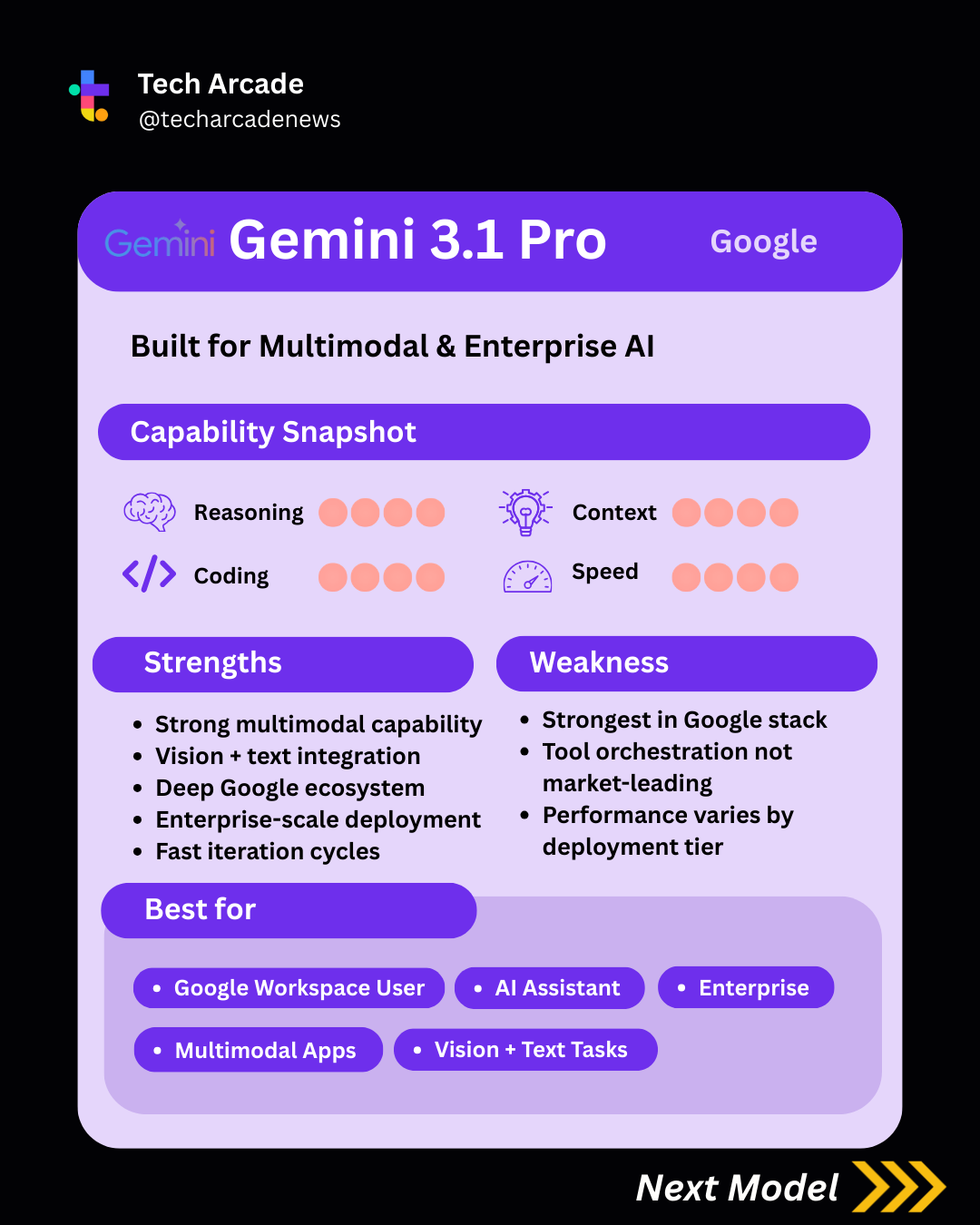
Let’s start with where it performs well.
Strengths of Gemini 3.1 Pro
- Strong multimodal capability
One of Gemini’s biggest strengths is multimodal processing.
Unlike earlier generations of AI models that primarily focused on text, Gemini was designed from the ground up to handle multiple types of inputs simultaneously, including:
• text
• images
• documents
• charts and visual data
This makes it particularly effective for tasks where information is not purely textual.
For example, Gemini can analyze:
• screenshots
• diagrams
• product images
• visual reports
and combine that information with written prompts to produce explanations or summaries.
For applications involving visual understanding combined with language, Gemini often performs very well.
- Deep integration with the Google ecosystem
Another major advantage of Gemini is its tight integration with Google’s infrastructure.
Gemini is already being integrated across a wide range of Google products and services, including:
• Google Workspace
• Google Docs and Sheets
• Google Cloud AI services
• Android systems
• Google Search enhancements
This gives Gemini a unique advantage for organizations already operating inside the Google Cloud and Workspace ecosystem.
Instead of building entirely new AI infrastructure, teams can often plug Gemini directly into existing workflows.
For enterprise users, that integration can be more valuable than pure benchmark performance.
- Large context capabilities
Gemini models are also known for supporting very large context windows, particularly in enterprise deployments.
Some Gemini configurations advertise context windows approaching or exceeding one million tokens, allowing the model to process extremely large inputs.
In practice, this allows Gemini to work with:
• very large documents
• multiple files at once
• long data analysis tasks
However, the exact limits can vary depending on the deployment tier and configuration.
- Fast iteration and deployment cycles
Because Gemini is deeply connected to Google’s infrastructure, it benefits from rapid deployment cycles and continuous updates.
Google frequently rolls out improvements across its models, tools, and APIs. For developers building inside Google Cloud, these updates can arrive quickly and integrate directly with existing services.
That said, the pace of iteration can sometimes mean that capabilities vary depending on which version or deployment tier you are using.
Limitations of Gemini 3.1 PRo
Despite its strengths, Gemini also has some trade-offs.
- Strongest inside the Google ecosystem
While it's a strength, it's also a limitation. Gemini works best when used within Google’s ecosystem.
For teams already using Google Cloud, Workspace, or Android integrations, this is a major advantage.
But for teams building completely independent AI stacks, the ecosystem lock-in can feel limiting compared to more neutral APIs.
- Tool orchestration not always market-leading
While Gemini performs well in many tasks, it is not always the first choice for agent-style tool orchestration.
Frameworks built for complex AI agents and multi-step automation are often optimized around OpenAI-style APIs, which currently have broader developer adoption.
This doesn’t mean Gemini cannot handle these workflows, but the surrounding tooling is sometimes less standardized.
- Performance can vary across versions
Another challenge with Gemini is that performance can vary depending on the model tier and deployment configuration.
Google offers multiple Gemini versions across consumer products, enterprise APIs, and cloud services.
Because of this, two users might both say they are using “Gemini,” while actually interacting with different capabilities or limits.
Best for
Gemini 3.2 Pro works particularly well for:
• multimodal applications
• vision + text analysis
• AI assistants integrated with Google products
• enterprise deployments using Google Cloud
• Workspace-based productivity tools
If your workflow involves images, documents, and Google services working together, Gemini can be a strong choice.
Overall
Gemini 3.2 Pro represents Google’s approach to AI: multimodal, ecosystem-driven, and deeply integrated into existing software platforms.
It may not always dominate every benchmark category, but its strength lies in handling multiple types of data and connecting AI directly into real-world applications.
For teams already operating inside the Google ecosystem, Gemini often feels less like a standalone AI tool and more like an extension of the platform they already use.
In short:
Excellent multimodal capability and strong enterprise integration, especially if your workflow already lives inside the Google ecosystem.