

What’s going on
A new electronic eye implant — just 2 mm × 2 mm and thinner than a human hair — has enabled previously blind patients (due to advanced Age‑related Macular Degeneration, specifically Geographic Atrophy) to read letters, numbers and words again. ScienceDaily+2LBC+2
- In a multicountry clinical trial involving 38 patients across five countries, 84% of participants regained the ability to read letters and words after receiving the implant. ScienceDaily+1
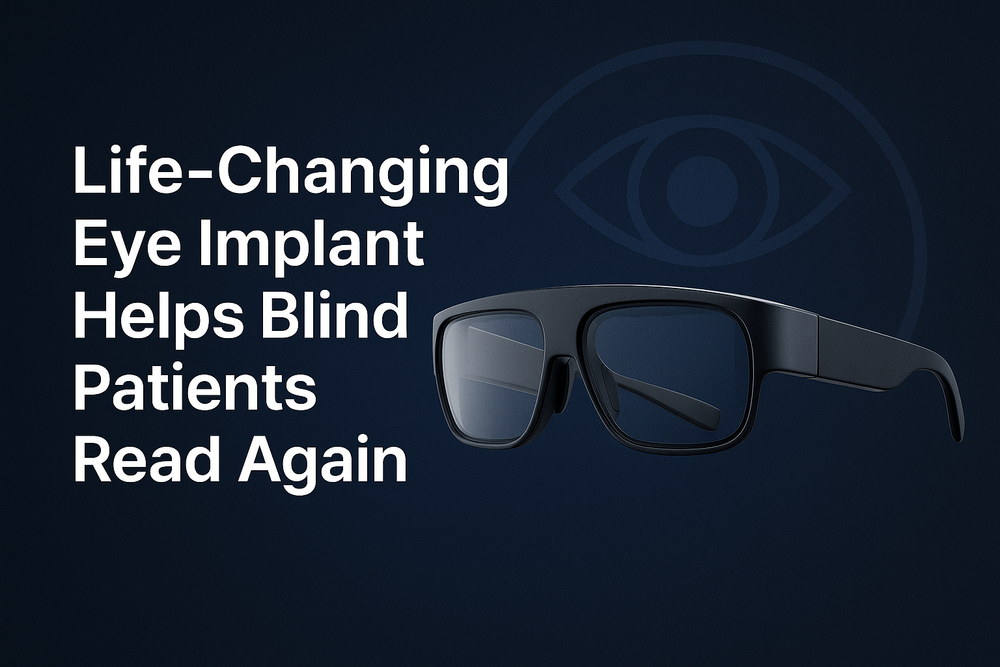
- The implant works by pairing with augmented reality glasses (camera + image processing) that send signals to the tiny chip under the retina, which then stimulates the eye’s remaining nerve cells and the brain. LBC+1
- The core condition treated, Geographic Atrophy (an advanced form of dry AMD), has until now had no effective treatment to restore central vision. LBC+1
How it works
- The patient wears a special set of AR-style glasses that include a video camera and a processing unit. ScienceDaily
- The camera captures the visual scene, the processing unit (often with AI) translates it into signals. LBC
- The tiny chip implanted under the retina receives the infrared/optical signal and converts it into electrical impulses that stimulate retinal neurons and the optic nerve. TweakTown
- With training and rehabilitation, patients learn to interpret the visual input (letters, words, shapes) and regain functional vision. The Guardian
Why this matters
- For patients: It’s a huge quality-of-life uplift — reading again, recognising details, gaining independence. One participant said her vision before the implant “was like having two black discs”. LBC
- For medicine & technology: This is one of the first times a device has restored meaningful central vision (reading letters/words) in a condition previously considered untreatable. It signals a new era for prosthetic vision. Financial Times
- For startups & deep tech: Shows that devices combining hardware (implant), software (processing), and systems (glasses + chip) are viable, high-impact bets. The ecosystem around “seeing again” is heating up.
- For investors and health systems: If this technology scales and gets regulatory approval, it opens a large market — millions of patients with AMD/GA and unmet vision-restoration needs.
Key details and caveats
- The trial size: 38 patients across 17 hospitals in 5 countries. LBC+1
- The procedure: typically under two hours, performed by trained surgeons in vitreoretinal surgery. ScienceDaily
- Limitations: While reading letters and words is a major step, full high-resolution vision (recognising faces easily, navigating complex environments) is not yet achieved. Rehabilitation is required. The Guardian
- Cost, accessibility, long-term durability still under investigation. The path from trial to widespread clinical use remains.
- The technology is currently aimed at central-vision loss in AMD/GA; other forms of blindness (optic nerve damage, congenital blindness) may require different approaches.
What to watch next
- Regulatory decisions: Speed and outcome of approvals in the U.S., Europe, UK will be key.
- Commercial rollout: Pricing, reimbursement strategies, training programmes for surgeons and patients.
- Expanded indications: Will this technology be adapted for other causes of blindness (e.g., retinitis pigmentosa, optic nerve disorders)?
- Technology evolution: Implants with more “pixels”, better resolution, wireless/miniaturised systems will drive wider use.
- User experience: Longer-term studies on how well vision is maintained, how patients cope, how real-world reading/navigation improve.