
🚀 Google Wants to Build Solar-Powered Data Centers...in Space!

🔥 What happened
Google is planning something straight out of sci-fi: data centers powered by the sun, orbiting in space.
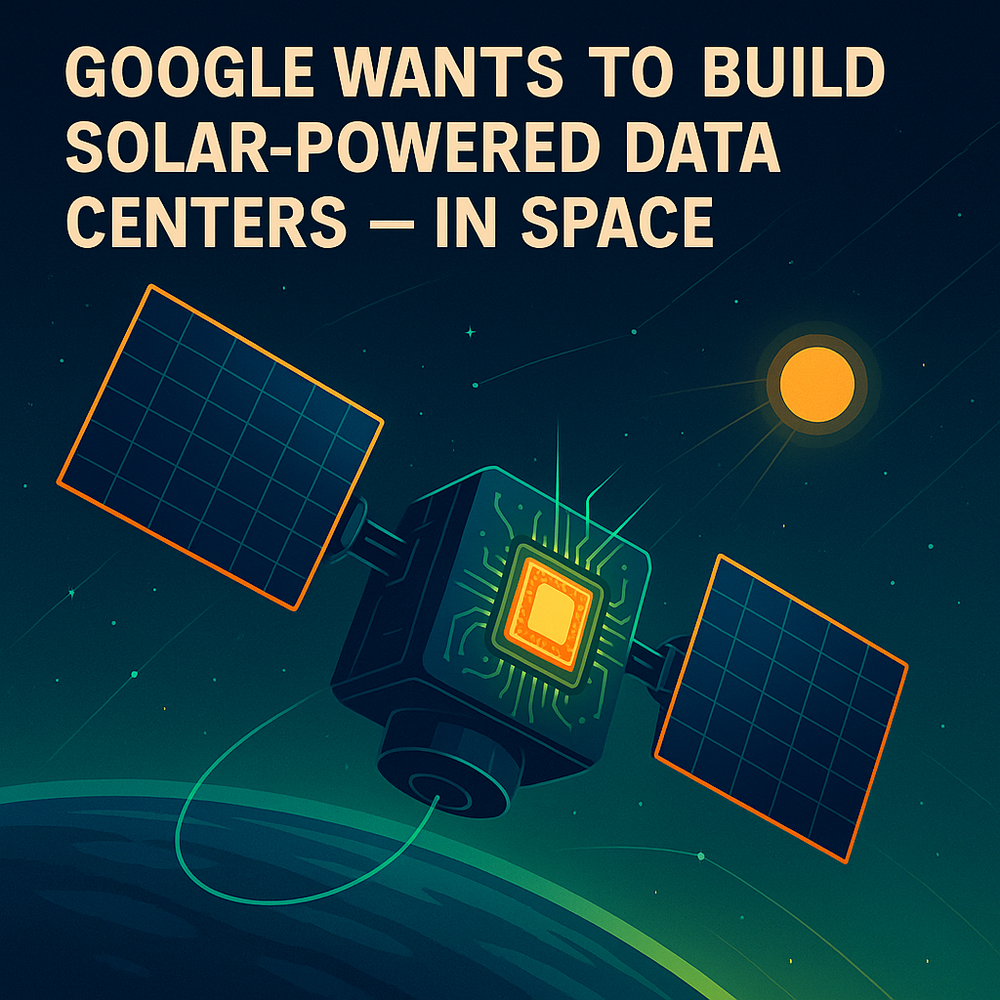
The project, called Project Suncatcher, would send satellites equipped with Google’s AI chips into low Earth orbit (about 400 miles above us). These satellites would run AI programs using solar power that’s stronger and more constant than on Earth.
Because there’s no atmosphere blocking sunlight, the solar panels can work up to eight times more efficiently than those on the ground. Google hopes to launch its first test satellites in 2027.
⚙️ How it works
- The satellites fly in an orbit where they get almost continuous sunlight, so they can keep generating power.
- That energy powers Google’s Tensor Processing Units (TPUs) — special chips designed to handle heavy AI work.
- Heat from all that computing is released into space using large metal radiators (since there’s no air in space to cool things down).
- The satellites would connect with each other using laser links, letting them act like one giant floating data center.
- Google believes that if rocket launches keep getting cheaper, this setup could match the cost of Earth-based data centers by the 2030s.
💡 Why it matters
- For you: Future Google AI features — like better translation, smarter search, or faster tools — could eventually use this space tech.
- For companies: It might make large-scale AI cheaper and more sustainable, since space has unlimited sunlight and natural cooling.
- For the world: It’s the next step in the AI arms race — moving from cloud computing to space computing.
⚠️ The reality check
- This is still a research project, not reality yet. There are huge challenges — building hardware that survives space radiation, handling maintenance, and keeping a stable internet connection from orbit.
- Rocket launches are cheaper now, but still expensive.
- Cooling computers in space is tricky — radiators can help, but it’s not as simple as running fans on Earth.
- Latency (delay) could make some tasks slower, depending on where the user is on Earth.
In short: it’s a bold idea, but it’ll take years of testing before it becomes useful.
👀 What’s next
- Google plans to launch the first prototype satellites in 2027 to test the concept.
- Expect to see more companies exploring space-based computing if this works — including Amazon and SpaceX.
- Governments will also start talking more about space regulations, because hundreds of orbiting servers could raise safety and debris issues.