

🔥 WHAT HAPPENED
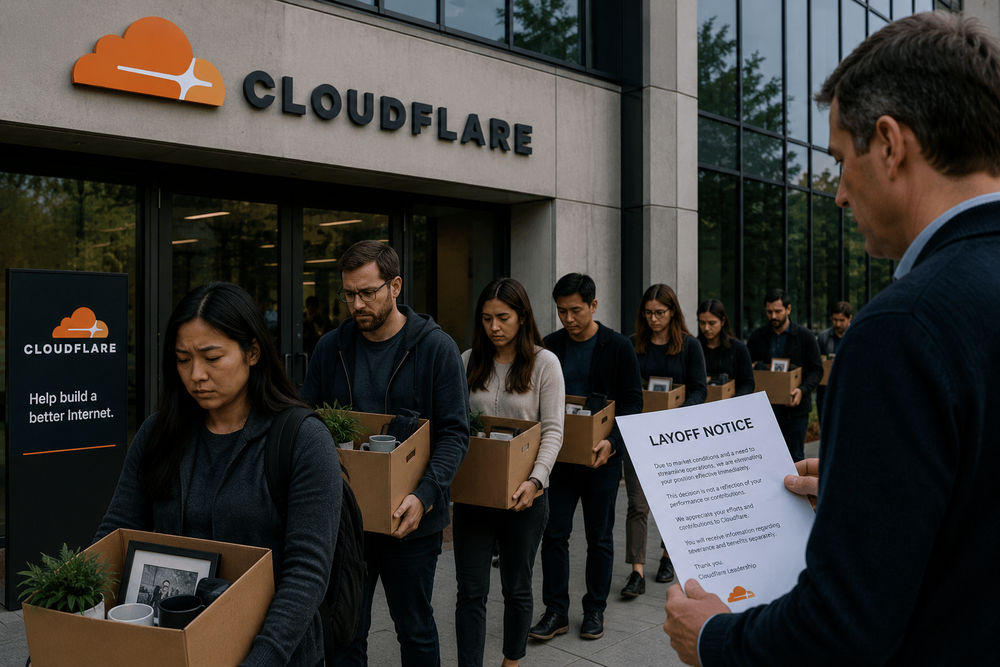
Cloudflare dropped a bombshell Thursday that has the entire tech industry on edge: the internet infrastructure giant is cutting more than 1,100 employees — roughly 20% of its global workforce — and the reason is unlike any we've heard before.
CEO Matthew Prince didn't cite cost-cutting. He didn't blame the economy. He said something that's going to reverberate through every corner of the industry: "Agentic AI has fundamentally changed how we work."
Here's the twist that makes this story terrifying for anyone in tech: Cloudflare just beat earnings expectations. Revenue hit $640 million (34% year-over-year growth), and earnings per share of 25 cents crushed the 23 cents analysts expected. This wasn't a company in trouble. This was a profitable, growing company that decided its workforce had become redundant because AI is just that good now.
The stock fell 18% in after-hours trading anyway. Because nothing scares investors quite like a company saying "we laid off 1,100 people and AI did their jobs."
🧠 WHY THIS MATTERS
This is the first time a major public company has explicitly used "agentic AI" as the primary justification for mass layoffs. Not "restructuring," not "efficiency initiatives," not "streamlining operations." Agentic AI. That's a chilling precedent.
Here's what Prince said on the earnings call: *"There are roles at this company that just aren't the roles that we need for the future."*
The memo Prince and co-founder Michelle Zatlyn sent to employees was even blunter. It said Cloudflare's AI usage had increased over 600% in the last three months alone. Employees across every department — engineering, HR, finance, marketing — now run thousands of AI agent sessions each day to get their work done. The message was clear: if AI agents can do it, those roles are gone.
This matters because Cloudflare isn't some AI hype company. They're a $2.8 billion revenue internet infrastructure business that powers a significant chunk of the web. When the infrastructure layer itself starts saying "we don't need as many humans," it's not a signal — it's a siren.
📊 DEEP DIVE
Let's look at the numbers, because they're genuinely wild:
- Revenue: $639.8M (up 34% YoY)
- EPS: $0.25 vs $0.23 expected
- Operating income: $73.1M (11.4% margin)
- Free cash flow: $84.1M (up 59% from last year)
- Large customers ($100K+): 4,416 (up 25%)
- Deals over $1M: up 73%
- AI usage internally: up 600% in 3 months
- Engineers using AI coding tools: 97%
- Developer platform users: 5.5 million (up 1M in a quarter)
- Total headcount: ~5,156 full-time employees
- Cuts: 1,100+ (roughly 20%)
- Severance: Full base pay through end of 2026
- Healthcare: Continued through year-end (US employees)
- Equity: Vested through August 15 (including for those under 1 year)
- Restructuring charges: $140M–$150M in 2026
Here's what makes this different from typical layoffs. When a struggling company cuts jobs, severance is usually the bare minimum. Cloudflare is offering more than 7 months of full pay plus accelerated equity vesting. That's not a soft landing — that's a golden parachute for 1,100 people. It tells you this wasn't about saving money. It was about transforming the company's structure.
Cloudflare's restructuring costs are $140M–$150M. Their annual payroll savings from cutting 20% of staff? Way more than that in the long run. If the average total comp per employee is ~$200K (standard for a Bay Area tech company at this scale), that's $220M+ in annual savings after a one-time $150M charge. The economics of replacing humans with AI agents just became very, very explicit.
⚠️ THE CATCH
Let's be honest about what Cloudflare isn't saying.
The "600% AI usage" number is impressive, but it doesn't tell the full story. Is the AI actually replacing human work quality, or is it replacing low-level busywork that probably shouldn't have required full-time humans in the first place? Cloudflare has always been a highly automated company. It was founded in 2009 with a philosophy of building smart infrastructure that reduces manual operations. The "600% increase" might be more about unlocking latent automation than true cognitive replacement.
The stock dropped 18% despite beating earnings. That tells you investors are nervous. When a high-growth company cuts 20% of staff even while growing 34%, the market reads it as a signal that growth might be slowing. Cloudflare's Q2 guidance of $664–$665M was right at the edge of analyst expectations — not a beat.
Gross margins took a hit: 72.8%, down from 73.9% last quarter. The company attributed this to growing developer platform revenue, which has lower margins than core CDN/security products. AI services aren't cheap to run.
And crucially: Cloudflare's AI products are mostly inference and model serving — they host AI, they don't build it from scratch. Their "agentic AI-first" model relies on third-party models (OpenAI, Anthropic, Meta, etc.). If those costs rise, the math changes.
🎯 WHAT HAPPENS NEXT
This is the story that's going to make every tech executive ask: "Should we be doing this too?"
Here's what to watch:
- The copycat effect: Other tech companies with strong AI adoption rates — think Datadog, MongoDB, Atlassian, ServiceNow — are going to face intense investor pressure to follow Cloudflare's lead. If they're also using AI at scale internally, why aren't they restructuring too?
- The Cloudflare AI platform bet: The company's Workers AI platform now has 5.5 million developers. They're betting big on being the infrastructure layer for AI agents. The layoffs free up resources to double down on this.
- The political fallout: Cloudflare was one of the tech companies that signed the voluntary AI testing pact with the U.S. government just days ago. Expect politicians and regulators to seize on this as evidence that AI regulation needs to address workforce displacement, not just safety.
- Union/worker response: Cloudflare's generous severance (full pay through end of 2026) is an attempt to buy goodwill. It may work in the short term, but the precedent it sets — "your job can be eliminated by AI even when the company is doing great" — is going to terrify tech workers.
- Other companies' Q1 earnings: The first quarter earnings season is still unfolding. Expect analysts to ask every tech company the same question: "What's your plan for agentic AI, and should we expect workforce changes?"
🧩 BIGGER PICTURE
This isn't just a Cloudflare story. It's the opening scene of a new act in the AI era.
We've spent the last two years focused on what AI can do — chatbots that write poems, image generators that make art, coding assistants that debug. We've been entertained, impressed, and sometimes scared. But the real story has always been about what AI changes about work.
Cloudflare just gave us the clearest answer yet: it changes everything.
600% more AI usage in 3 months. 97% of engineers using AI coding tools. Thousands of AI agent sessions running daily across HR, finance, and marketing. And 1,100 people — people who helped build one of the internet's most important companies — are out of a job because the company no longer needs as many humans to do the work.
The old narrative was "AI will augment workers, not replace them." Cloudflare's CEO just wrote a new one: "AI doesn't just augment. It restructures."
Here's the thing that should keep tech workers up at night: this wasn't a struggling company cutting costs. This was a thriving company with 34% revenue growth that decided its workforce was 20% too big because AI filled the gap. If profitable, growing companies are making this calculus, the next downturn — when real cost-cutting pressures emerge — could be catastrophic for white-collar employment.
Matthew Prince ended his memo with a line that's going to be quoted for years: *"Today's actions are not a cost-cutting exercise or an assessment of individuals' performance; they are about Cloudflare defining how a world-class, high-growth company operates and creates value in the agentic AI era."*
In other words: this is the new normal. And it's happening whether we're ready or not.