
🇨🇳 What happened
China is tightening control over its booming influencer economy.
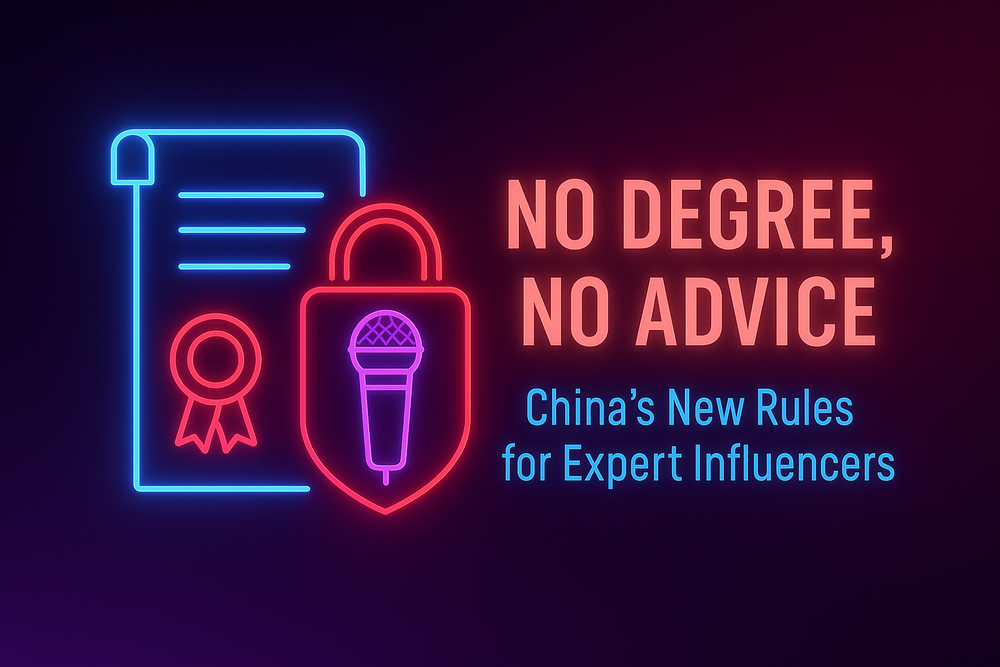
New rules mean that creators who discuss professional topics, such as finance, medicine, education, or law, must prove they’re qualified before they can post or stream.
That means verified degrees, licenses, or other credentials filed with platforms.
Meanwhile, lifestyle and entertainment influencers are also facing closer scrutiny as regulators push to keep online speech “healthy” and in line with official guidance on public opinion.
So yes... your favorite health vlogger in Beijing might soon need a diploma check before recommending vitamins. 🩺
⚙️ How it works
The Cyberspace Administration of China (CAC) and other regulators have introduced a layered system combining credential checks, platform accountability, and agency registration:
🎓 Credential verification:
Influencers producing content in “professional fields” must upload proof of qualifications (degrees or licenses) to verify expertise. Platforms are responsible for confirming these before allowing content to go public.
🧾 Ad disclosure:
Under the Measures for the Administration of Internet Advertising (effective May 1, 2023), all paid promotions must be clearly labeled as advertisements (“广告”). Undisclosed endorsements are treated as illegal advertising.
🧩 MCN registration:
Influencer management agencies (multi-channel networks, or MCNs) must register with the government, list all affiliated creators, and ensure compliance with political and ideological standards.
🧍♂️ Platform responsibility:
Major platforms like Douyin (TikTok China), Bilibili, and Weibo are now accountable for vetting influencer credentials, monitoring political content, and ensuring that videos, livestreams, and posts remain “politically correct” and “socially responsible.”
Basically, China’s influencer world just shifted from free-market hustle to licensed profession.
🧮 Why it matters
The government says this is about curbing misinformation, stopping unqualified influencers from giving misleading advice on health or finance.
But it’s also about managing influence.
By deciding who can speak about what, regulators are tightening control over the spread of narratives across China’s massive digital ecosystem, ensuring that online content aligns with official notions of “public opinion guidance” (舆论引导).
In short: less chaos, more “correct direction.” 🧭
🔍 The impact
For creators:
- Higher entry barriers — credentials, registration, and vetting.
- Unverified influencers risk content takedowns or account suspension.
- Even lifestyle content can be flagged for “showing off wealth” or promoting “unhealthy values.”
For brands:
- Partnerships now require compliance checks.
- Every paid collaboration must be clearly disclosed.
- Contracts should verify that influencers are properly registered and compliant.
For platforms:
- Must register and monitor both influencers and MCNs.
- Algorithms may downrank or restrict “unverified” or politically risky creators.
- Failure to enforce these rules could lead to platform penalties.
💬 The bigger picture
This is part of a larger pattern: China is turning its once-chaotic influencer market into a regulated digital industry that mirrors traditional media.
It’s not just about censorship, it’s about structure and traceability.
Beijing wants influencers to behave like certified professionals, not rogue broadcasters.
That means more oversight, but also more credibility, at least on paper.
This also means an internet that’s a bit safer, more predictable, and far less spontaneous.
🪩 TL;DR
China now requires influencers to verify degrees, disclose ads, and follow ideological content rules.
✅ More trust
🚫 Less freedom
📉 Higher barriers
🧱 Stronger state oversight
The influencer economy isn’t dead — it’s just graduating… with government honors. 🎓