
For years, the standard medical advice for a child diagnosed with Sanfilippo syndrome type A was almost unbearable in its plainness: take your kid home and love them. There was nothing else. No drug, no procedure, no slowing it down. The disease empties out a child's brain a little more each month until it kills them, usually before they finish being teenagers.
On September 17, that changed.
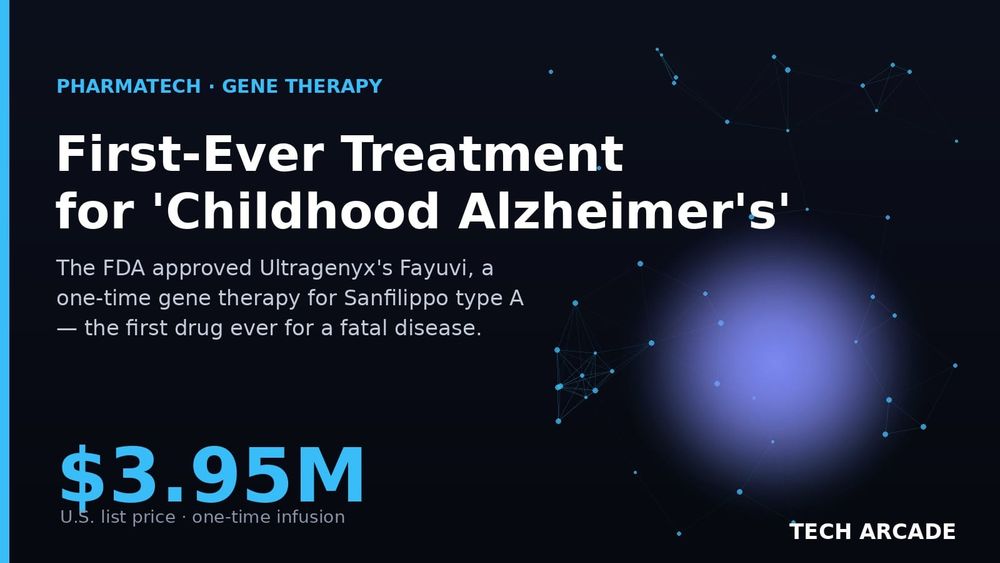
Let's get the number on the table first: $3.95 million. That's the U.S. list price Ultragenyx set for Fayuvi (generic name rebisufligene etisparvovec-hopf), the first treatment the FDA has ever approved for Sanfilippo type A, one of the most expensive medicines in the world (BioSpace). It is a one-time infusion. For roughly 3,000 to 5,000 children who currently have no other option, it is also the only thing standing between them and a disease with a 100% fatality rate (Ultragenyx).
The headline writes itself as a sticker-shock story. The real one is harder: this is what a genuine first-in-history treatment costs when the patient pool is measured in thousands, not millions.
🧠 Why This Matters
Sanfilippo type A, known in the clinic as MPS IIIA, is sometimes called "childhood Alzheimer's" (STAT). Kids are born with a broken copy of the SGSH gene, so their cells can't make an enzyme called sulfamidase. Without it, a sugar molecule called heparan sulfate piles up inside cells and wrecks the nervous system. Toddlers who were hitting milestones start losing speech, then motor skills, then everything. The median life expectancy is about 15 years (Ultragenyx).
Until this week, every one of those trajectories ran in a single direction. Fayuvi is the first approved thing that bends the line.
"It's hard to overstate what this approval would mean for everybody who is living with this really horrific disease. When patients and families receive this shocking diagnosis, they wouldn't be told to take their kids home and love them. They would be given hope and an action plan for treatment."
— Cara O'Neill, chief science officer, Cure Sanfilippo Foundation (STAT)
📊 Deep Dive
Fayuvi is a gene therapy, so it goes after the cause rather than the symptoms. It uses a modified, non-infectious virus (an AAV9 vector) to ferry a working copy of the SGSH gene into the body through a single IV infusion. Once inside, cells start making sulfamidase again and clearing out the heparan sulfate that was poisoning them (FDA).
The approval rests on the Transpher A trial, and the numbers are the reason regulators moved. Here's how the pieces stack up:
- The evidence: 17 treated children (the primary analysis group) measured against a 27-patient natural-history group who got no therapy. Treated kids scored 23.5 points higher on the Bayley-III cognitive scale (p<0.0001), with follow-up now stretching to nearly eight years (Ultragenyx).
- The biology: a one-time IV gene therapy that restores a missing enzyme, versus a prior standard of care that was, literally, nothing.
- The regulatory weight: Orphan Drug, Fast Track, and Breakthrough Therapy designations all stacked on one approval (FDA).
- The economics: a $3.95M list price against a patient pool of 3,000–5,000 in accessible markets, plus a priority review voucher Ultragenyx now holds that trades for around $200 million on the open market (Benzinga).
That last line is the tell. When your addressable market tops out around 5,000 patients, the math that lets a company recoup a decade of R&D looks nothing like a cholesterol pill. Investors clocked it fast: Ultragenyx shares jumped 13% the day of the approval (BioSpace).
⚠️ The Catch
A first-ever anything comes with fine print, and Fayuvi's is real. The FDA flagged a risk of thrombotic microangiopathy — a serious clotting condition — along with a longer-term theoretical risk that the delivered genetic material could integrate into a patient's DNA and, over time, raise cancer risk. To blunt the immune response, kids have to start corticosteroids the day before infusion and stay on them for at least eight weeks (FDA).
Then there's the ceiling on the upside. Fayuvi is approved for children aged 2 to 5, and the trial measured a slowing of decline, not a reversal — kids who have already lost significant ground don't get it back. And the price runs into the same wall every million-dollar gene therapy hits: insurers, Medicaid programs, and hospitals have to pay $3.95 million per patient up front for a benefit that plays out over years.
🎯 What Happens Next
Ultragenyx says commercial supply will ship to qualified treatment centers within 30 to 60 days (Ultragenyx), which means the first non-trial children could be infused before Thanksgiving. The near-term fight moves from the lab to the billing office: newborn screening for MPS IIIA is patchy, and a therapy that only helps young children is worthless if kids get diagnosed too late to qualify.
"We recognize the profound urgency of making this therapy available to families, and our focus now is on supporting timely access in the U.S."
— Emil Kakkis, CEO, Ultragenyx (FiercePharma)
Wall Street is measured about the business itself. William Blair rated the stock Market Perform, with analyst Sami Corwin modeling roughly $325 million in peak sales for Fayuvi and noting a thin slate of near-term catalysts (Benzinga). For a $3.95M drug, $325 million a year is a rounding error at the top of the pharma table — and a lifeline for the families who need it.
🧩 Bigger Picture
Fayuvi lands in the middle of an argument the industry has been having with itself for a decade. Gene therapies keep proving they can do what nothing else can — one shot, at the root of the disease — and keep arriving with prices that make health systems flinch. The priority review voucher, worth about $200 million, is the government's way of subsidizing this exact kind of bet, because the free market alone won't fund a treatment for 5,000 kids.
The FDA, for its part, framed the approval as a signal about where it wants the science to go.
"Gene therapy holds tremendous promise for rare diseases like Sanfilippo syndrome type A, and this milestone reflects the FDA's commitment to action."
— Kyle Diamantas, Acting FDA Commissioner (FDA)
For a parent who spent years being told there was nothing to do, the $3.95 million question is the easy one. The hard part was always the years of nothing that came before it. This week, for the first time, there's something.
Sources
- FDA — FDA Approves First Gene Therapy for Pediatric Patients With Sanfilippo Syndrome Type A
- Ultragenyx — Announces Approval of FAYUVI, First-Ever FDA-Approved Treatment for Sanfilippo Syndrome Type A
- STAT — FDA approves first-ever gene therapy for Sanfilippo syndrome
- FiercePharma — FDA approves Ultragenyx's gene therapy Fayuvi
- BioSpace — Ultragenyx wins FDA greenlight for first Sanfilippo therapy, priced at nearly $4M
- Benzinga — Ultragenyx Wins First Sanfilippo Approval As Analyst Keeps Ratings Modest